Wednesday, August 9, 2017

Ak-Say canyon

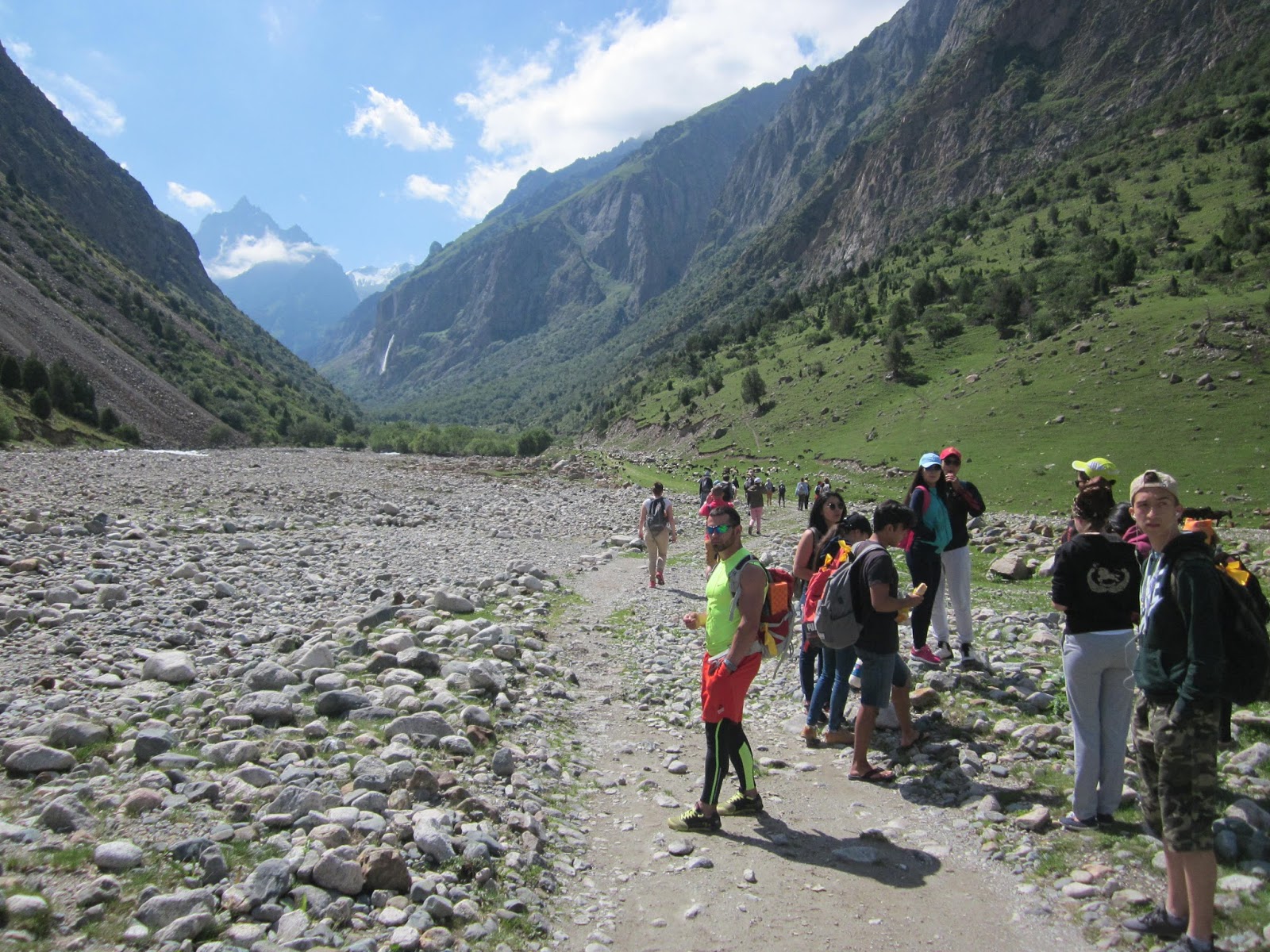
Apparently in Kyrgyzstan, as soon as there are a few mountains together, they name it canyon, as in Ala-Archa or in Sokuluk. But I have always the feeling that these sites don't really deserve to be called so; they are just regular valleys! For me a canyon has to be like the Grand Canyon or like Petra, with almost vertical walls (disclaimer: I've neither been to the Grand Canyon nor Petra).

This time, we hiked through a scenic canyon that didn't usurped its name: Ak-Say, located on the south shore of the Issyk-Kul lake.

The entry is a few kilometers west from the town of Bokonbaevo. 

Milena ready to start the walk. She loves to hike on mom's back. 

I was always behind as I kept on taking pictures.

There are a few cars driving through the canyon to the beach.

I could catch up my cousin Eliane, also stopping for pictures.

Ak-Say definitely suits my own definition of a canyon.

Toward the end, I could climb on the ridge to have another point of view. 

After about one hour walk, Issyk-Kul is on sight.

We ate on the beach and swam in the lake.

The water was surprisingly warm.

Then we climbed a small hill. 

It is called the Geologist's Peak.

It is only about 100 meters elevation.

The view from the top is amazing.

Towards east.

Towards north.

Towards west.

Towards south.

Sunday, August 6, 2017

Horseback games

For the first night of the tour, we stayed in the small and remote village of Karan-Dobo, in the Kemin District. The owner of our guesthouse sometimes organize traditional horseback games for their hosts. Luckily they did so during the evening we were there. 

The games consist of various competitions on horses. Even if the participants are only demonstrating for the tourists, they don't take it lightly, as one participant punched another one in the face after an animated game phase.

 Opening ceremony.

Presentation of the participants.

 The first game was udarysh, where two riders wrestle in order to unhorse each other.

Then kuz-kumai (catch the girl), played with one male and one female rider.

 The male rider get to chase the woman to (rather briefly) kiss her. In the return leg, it's the woman who follows her suitor, and whips him if she catches up!

I did not get a kiss, but fortunately no whiplash either.

The main game is ulak-tartysh, where two teams of competitors fight for a... headless goat's carcass (that you can see under the leg of the horse rider above).

 First the riders gallop past the goat's carcass trying to pick it up off the ground.

 It is followed by a chaotic brawl to get control of the goat.

 Then the team that secured the goat rushes toward the side of the other team.

And drop the carcass off in the opponent's circular goal.

Friday, August 4, 2017

Burana Tower

After a few days in Bishkek, we've started our tour around Kyrgyzstan. There are the four of us, along with our french speaking local guide Talant and our driver Dima. This configuration gives us flexibility in case we need to improvise another program if Milena does not support the altitude of the highest sights.

Our first stop is Burana Tower, a 25 meter high minaret near the city of Tokmok, around 70 km east of Bishkek. It was built during the 11th century by the Sogdians - an Iranian civilization - and then taken by the Karakhanids, the people of Turkic descent who spread Islam in Central Asia. It used to be part of the thriving city of Balasagun until an earthquake completely destroyed it 500 years ago.

During the last century, local people did not considered the tower as much more than a reserve of bricks for other construction projects. As a result, it was in danger of collapsing when the soviets renovated it at the beginning of the 1970s.

 Burana Tower in front of the Tian Shan mountains.

 It was originally about 45 meter high. The earthquake that wiped out Balasagun also destroyed its top half. 

There is an open air museum around the minaret with a collection of artifacts found in the region.

Some antique... stuff.

 A petroglyph depicting a deer hunting scene.

Turkic gravestones are sculpted with a bowl and a knife in each hand. 
The bowl to welcome friends; the knife to greet foes.  

Beside the tower, there are almost no remains of the Balasagun citadel. 

The region of Tokmok viewed from the top.

The stairway within the tower is steep, dark and narrow. 

 The four of us in front of the Burana tower.

Sunday, July 30, 2017

Supara

Look who I've found here in Kyrgyzstan: my girlfriend Lilia, my daughter Milena and my cousin Eliane!


After one month in Bishkek I have completed the first stage of my trip, as I am now done with school. My family joined me here for two weeks of holidays... within what actually already is holidays for me.

For the current week, we have booked an organized tour in the countryside with a guide and a driver. Afterwards Eliane flies back to Switzerland while Lilia, Milena and I spend a few more days together in the capital. I will then stay again on my own one more month in Karakol, a town in the Tian Shan mountains on the east shore of Issyk-Kul.

 
We've been all together to Supara, an ethno-complex (as they call it) near Bishkek.

 It is a restaurant that serves typical Kyrgyz food in a traditional setting. 

 The (beautiful) complex is mostly built with stones and wood.

Each yurt is decorated with a different theme.

Sunday, July 23, 2017

Sokuluk and Issyk-Ata

Last week-end I went again in the mountains around Bishkek. I booked two excursions with TUK - the Trekking Union of Kyrgyzstan. They organize tours in groups that cost next to nothing: about 6€ for a one day trip, including transport and a guide. It is a good way to meet local people as well as expats or tourists while discovering beautiful landscapes.

On Saturday we've been to Sokuluk Canyon, in the south-west of Bishkek. Its main attraction is an impressive waterfall, the 60 meter high Belogorka Waterfall.

Starting the hike with the whole group, about 30 persons.

 Following the Sokuluk River up to the waterfall.

The Belogorka Waterfall.

On Sunday we visited Issyk-Ata, an old Soviet Sanatorium built in 1891 with hot water springs and baths. Unfortunately the guide didn't spoke well English and only gave explanations about the Sanatorium in Russian. We then walked along the valley until a small waterfall, and to a view-point over the Issyk-Ata River.

The entrance of the Issyk-Ata sanatorium.

Walking through the Issyk-Ata Valley.

The waterfall, not as impressive as the one in Sokuluk.

 Overlooking the Issyk-Ata River.